
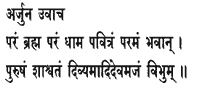
Arjuna said: Thou art the supreme Brahman, the supreme Abode, the supreme Purity, the one permanent, the divine Purusha, the original Godhead, the Unborn, the all-pervading Lord.
God in Power of Becoming
Sri Aurobindo
AVERY important step has been reached, a decisive statement of its metaphysical and psychological synthesis has been added to the development of the Gita’s gospel of spiritual liberation and divine works. The Godhead has been revealed in thought to Arjuna; he has been made visible to the mind’s search and the heart’s seeing as the supreme and universal Being, the supernal and universal Person, the inward-dwelling Master of our existence for whom man’s knowledge, will and adoration were seeking through the mists of the Ignorance. There remains only the vision of the multiple Virat Purusha to complete the revelation on one more of its many sides. The metaphysical synthesis is complete. Sankhya has been admitted for the separation of the soul from the lower nature,— a separation that must be effected by self-knowledge through the discriminating reason and by transcendence of our subjection to the three gunas constituent of that nature. It has been completed and its limitations exceeded by a large revelation of the unity of the supreme Soul and supreme Nature, para purus.a, par¯a prakr.ti. Vedanta of the philosophers has been admitted for the self-effacement of the natural separative personality built round the ego. Its method has been used to replace the little personal by the large impersonal being, to annul the separative illusion in the unity of the Brahman and to substitute for the blind seeing of the ego the truer vision of all things in one Self and one Self in all things. Its truth has been completed by the impartial revelation of the Parabrahman from whom originate both the mobile and the immobile, the mutable and the immutable, the action and the silence. Its possible limitations have been transcended by the intimate revelation of the supreme Soul and Lord who becomes here in all Nature, manifests himself in all personality and puts forth the power of his Nature in all action. Yoga has been admitted for the self-surrender of the will, mind, heart, all the psychological being to the Ishwara, the divine Lord of the nature. It has been completed by the revelation of the supernal Master of existence as the original Godhead of whom the Jiva is the partial being in Nature. Its possible limitations have been exceeded by the soul’s seeing of all things as the Lord in the light of a perfect spiritual oneness. There results an integral vision of the Divine Existent at once as the transcendent Reality, supracosmic origin of cosmos, as the impersonal Self of all things, calm continent of the cosmos, and as the immanent Divinity in all beings, personalities, objects, powers and qualities, the Immanent who is the constituent self, the effective nature and the inward and outward becoming of all existences. The Yoga of knowledge has been fulfilled sovereignly in this integral seeing and knowing of the One. The Yoga of works has been crowned by the surrender of all works to their Master,—for the natural man is now only an instrument of his will. The Yoga of love and adoration has been declared in its amplest forms. The intense consummation of knowledge and works, love conducts to a crowning union of soul and Oversoul in a highest amplitude. In that union the revelations of knowledge are made real to the heart as well as to the intelligence. In that union the difficult sacrifice of self in an instrumental action becomes the easy, free and blissful expression of a living oneness. The whole means of the spiritual liberation has been given; the whole foundation of the divine action has been constructed. Arjuna accepts the entire knowledge that has thus been given to him by the divine Teacher. His mind is already delivered from its doubts and seekings; his heart, turned now from the outward aspect of the world, from its baffling appearance to its supreme sense and origin and its inner realities, is already released from sorrow and affliction and touched with the ineffable gladness of a divine revelation. The language which he is made to use in voicing his acceptance is such as to emphasise and insist once again on the profound integrality of this knowledge and its all-embracing finality and fullness. He accepts first the Avatar, the Godhead in man who is speaking to him as the supreme Brahman, as the supracosmic All and Absolute of existence in which the soul can dwell when it rises out of this manifestation and this partial becoming to its source, param˙ brahma, param˙ dh¯ama. He accepts him as the supreme purity of the ever free Existence to which one arrives through the effacement of ego in the self’s immutable impersonality calm and still for ever, pavitram˙ paramam. He accepts him next as the one Permanent, the eternal Soul, the divine Purusha, purus.am˙ s´a¯s´vatam˙ divyam. He acclaims in him the original Godhead, adores the Unborn who is the pervading, indwelling, self-extending master of all existence, a¯di-devam ajam˙ vibhum.He accepts him therefore not only as that Wonderful who is beyond expression of any kind, for nothing is sufficient to manifest him,—“neither the Gods nor the Titans, O blessed Lord, know thy manifestation,” na hi te bhagavan vyaktim˙ vidur deva¯ na da¯nava¯h. ,—but as the lord of all existences and the one divine efficient cause of all their becoming, God of the gods from whom all godheads have sprung, master of the universe who manifests and governs it from above by the power of his supreme and his universal Nature, bhu¯ tabha ¯vana bhu¯ tes´a deva-deva jagat-pate. And lastly he accepts him as that Vasudeva in and around us who is all things here by virtue of the world-pervading, all-inhabiting, all-constituting master powers of his becoming, vibhu¯ tayah. , “the sovereign powers of thy becoming by which thou standest pervading these worlds,” y¯abhir vibh ¯ utibhir lok¯an im¯a ˙ ms tva ˙ m vy¯apya tis.t. hasi.1 He has accepted the truthwith the adoration of his heart, the submission of his will and the understanding of his intelligence. He is already prepared to act as the divine instrument in this knowledge and with this self-surrender. But a desire for a deeper constant spiritual realisation has been awakened in his heart and will. This is a truth which is evident only to the supreme Soul in its own self-knowledge,—for, cries Arjuna, “thou alone, O Purushottama, knowest thyself by thyself,” a¯tmana¯ a¯tma¯nam˙ vettha. This is a knowledge that comes by spiritual identity and the unaided heart, will, intelligence of the natural man cannot
arrive at it by their own motion and can only get at imperfect mental reflections that reveal less than they conceal and disfigure. This is a secret wisdom which one must hear from the seers who have seen the face of this Truth, have heard its word and have become one with it in self and spirit. “All the Rishis say this of thee and the divine seer Narada, Asita, Devala, Vyasa.” Or else one must receive it from within by revelation and inspiration from the inner Godhead who lifts in us the blazing lamp of knowledge. Svayan˜ caiva bravı¯s.i me, “and thou thyself sayest it to me.” Once revealed, it has to be accepted by the assent of the mind, the consent of the will and the heart’s delight and submission, the three elements of the complete mental faith, ´sraddh¯a. It is so that Arjuna has accepted it; “all this that thou sayest, my mind holds for the truth.” But still there will remain the need of that deeper possession in the very self of our being out from its most intimate psychic centre, the soul’s demand for that inexpressible permanent spiritual realisation of which the mental is only a preliminary or a shadow and without which there cannot be a complete union with the Eternal. Now the way to arrive at that realisation has been given to Arjuna. And so far as regards the great self-evident divine principles, these do not baffle the mind; it can open to the idea of the supreme Godhead, to the experience of the immutable Self, to the direct perception of the immanent Divinity, to the contact of the conscient universal Being. One can, once the mind is illumined with the idea, follow readily the way and, with whatever preliminary difficult effort to exceed the normal mental perceptions, come in the end to the self-experience of these essential truths that stand behind our and all existence, ¯atman¯a ¯atm¯anam. One can do it with this readiness because these, once conceived, are evidently divine realities; there is nothing in our mental associations to prevent us from admitting God in these high aspects. But the difficulty is to see him in the apparent truths of existence, to detect him in this fact of Nature and in these disguising phenomena of the world’s becoming; for here all is opposed to the sublimity of this unifying conception. How can we consent to see the Divine as man and animal being and inanimate object, in the noble and the low, the sweet and the terrible, the good and the evil? If, assenting to some idea of God extended in the things of the cosmos, we see him in ideal light of knowledge and greatness of power and charm of beauty and beneficence of love and ample largeness of spirit, how shall we avoid the breaking of the unity by their opposites which in actual fact cling to these high things and envelop them and obscure? And if in spite of the limitations of human mind and nature we can see God in the man of God, how shall we see him in those who oppose him and represent in act and nature all that we conceive of as undivine? If Narayana is without difficulty visible in the sage and the saint, how shall he be easily visible to us in the sinner, the criminal, the harlot and the outcaste? To all the differentiations of the world-existence the sage, looking everywhere for the supreme purity and oneness, returns the austere cry, “not this, not this,” neti neti. Even if to many things in the world we give a willing or reluctant assent and admit the Divine in the universe, still before most must not themind persist in that cry “not this, not this”? Here constantly the assent of the understanding, the consent of the will and the heart’s faith become difficult to a human mentality anchored always on phenomenon and appearance. At least some compelling indications are needed, some links and bridges, some supports to the difficult effort at oneness. Arjuna, though he accepts the revelation of Vasudeva as all and though his heart is full of the delight of it,—for already he finds that it is delivering him from the perplexity and stumbling differentiations of his mind which was crying for a clue, a guiding truth amid the bewildering problems of a world of oppositions, and it is to his hearing the nectar of immortality, amr.tam, —yet feels the need of such supports and indices. He feels that they are indispensable to overcome the difficulty of a complete and firm realisation; for how else can this knowledge be made a thing of the heart and life? He requires guiding indications, asks Krishna even for a complete and detailed enumeration of the sovereign powers of his becoming and desires that nothing shall be left out of the vision, nothing remain to baffle him. “Thou shouldst tell me” he says “of thy divine self-manifestations in thy sovereign power of becoming, divya¯ a¯tma-vibhu¯ tayah. , all without exception,—a´ses.en. a, nothing omitted,—thy Vibhutis by which thou pervadest these worlds and peoples. How shall I know thee, O Yogin, by thinking of thee everywhere at all moments and in what pre-eminent becomings should I think of thee?” This Yoga by which thou art one with all and one in all and all are becomings of thy being, all are pervading or pre-eminent or disguised powers of thy nature, tell me of it, he cries, in its detail and extent, and tell me ever more of it; it is nectar of immortality to me, and however much of it I hear, I am not satiated. Here we get an indication in the Gita of something which the Gita itself does not bring out expressly, but which occurs frequently in the Upanishads and was developed later on by Vaishnavism and Shaktism in a greater intensity of vision, man’s possible joy of the Divine in the world-existence, the universal Ananda, the play of theMother, the sweetness and beauty of God’s Lila.2 The divine Teacher accedes to the request of the disciple, but with an initial reminder that a full reply is not possible. For God is infinite and his manifestation is infinite. The forms of his manifestation too are innumerable. Each form is a symbol of some divine power, vibhu¯ ti, concealed in it and to the seeing eye each finite carries in it its own revelation of the infinite. Yes, he says, I will tell thee of my divine Vibhutis, but only in some of my principal pre-eminences and as an indication and by the example of things in which thou canst most readily see the power of the Godhead, pr¯adh¯anyatah. , udde´satah. . For there is no end to the innumerable detail of the Godhead’s self-extension in the universe, n¯ asti anto vistarasya me. This reminder begins the passage and is repeated at the end in order to give it a greater and unmistakable emphasis. And then throughout the rest of the chapter3 we get a summary description of these principal indications, these pre-eminent signs of the divine force present in the things and persons of the universe. It seems at first as
if they were given pell-mell, without any order, but still there is a certain principle in the enumeration, which, if it is once disengaged, can lead by a helpful guidance to the inner sense of the idea and its consequences. The chapter has been called the Vibhuti-Yoga,—an indispensable yoga. For while we must identify ourselves impartially with the universal divine Becoming in all its extension, its good and evil, perfection and imperfection, light and darkness, we must at the same time realise that there is an ascending evolutionary power in it, an increasing intensity of its revelation in things, a hierarchic secret something that carries us upward from the first concealing appearances through higher and higher forms towards the large ideal nature of the universal Godhead. This summary enumeration begins with a statement of the primal principle that underlies all the power of this manifestation in the universe. It is this that in every being and object God dwells concealed and discoverable; he is housed as in a crypt in the mind and heart of every thing and creature, an inner self in the core of its subjective and its objective becoming, one who is the beginning and middle and end of all that is, has been or will be. For it is this inner divine Self hidden from the mind and heart which he inhabits, this luminous Inhabitant concealed from the view of the soul in Nature which he has put forth into Nature as his representative, who is all the time evolving the mutations of our personality in Time and our sensational existence in Space,—Time and Space that are the conceptual movement and extension of the Godhead in us. All is this selfseeing Soul, this self-representing Spirit. For ever from within all beings, from within all conscient and inconscient existences, this All-conscient develops his manifested self in quality and power, develops it in the forms of objects, in the instruments of our subjectivity, in knowledge and word and thinking, in the creations of the mind and in the passion and actions of the doer, in the measures of Time, in cosmic powers and godheads and in the forces of Nature, in plant life, in animal life, in human and superhuman beings. If we look at things with this eye of vision unblinded by differentiations of quality and quantity or by difference of values and oppositions of nature, we shall see that all things are in fact and can be nothing but powers of his manifestation, vibhutis of this universal Soul and Spirit, Yoga of this great Yogin, self-creations of this marvellous self-Creator. He is the unborn and the all-pervading Master of his own innumerable becomings in the universe, ajo vibhuh. ; all things are his powers and effectuations in his self-Nature, vibhutis. He is the origin of all they are, their beginning; he is their support in their everchanging status, theirmiddle; he is their end too, the culmination or the disintegration of each created thing in its cessation or its disappearance. He brings them out from his consciousness and is hidden in them, he withdraws them into his consciousness and they are hidden in him for a time or for ever. What is apparent to us is only a power of becoming of the One: what disappears from our sense and vision is effect of that power of becoming of the One. All classes, genera, species, individuals are such vibhutis. But since it is through power in his becoming that he is apparent to us, he is especially apparent in whatever is of a pre-eminent value or seems to act with a powerful and pre-eminent force. And therefore in each kind of being we can see him most in those in whom the power of nature of that kind reaches its highest, its leading, its most effectively selfrevealing manifestation. These are in a special sense Vibhutis. Yet the highest power and manifestation is only a very partial revelation of the Infinite; even the whole universe is informed by only one degree of his greatness, illumined by one ray of his splendour, glorious with a faint hint of his delight and beauty. This is in sum the gist of the enumeration, the result we carry away from it, the heart of its meaning. God is imperishable, beginningless, unending Time; this is his most evident Power of becoming and the essence of the whole universal movement. Aham eva aks.ayah. k¯alah.. In that movement of Time and Becoming God appears to our conception or experience of him by the evidence of his works as the divine Power who ordains and sets all things in their place in the movement. In his form of Space it is he who fronts us in every direction, million-bodied, myriad-minded, manifest in each existence; we see his faces on all sides of us. Dh¯ at ¯a ’ha ˙m vi´svato-mukhah. . For simultaneously in all these many million persons and things, sarva-bhu¯ tes.u, there works the mystery of his self and thought and force and his divine genius of creation and his marvellous art of formation and his impeccable ordering of relations and possibilities and inevitable consequences. He appears to us too in the universe as the universal spirit of Destruction, who seems to create only to undo his creations in the end,—“I am all-snatching Death,” aha ˙m mr. tyuh. sarvaharah. . And yet his Power of becoming does not cease from its workings, for the force of rebirth and new creation ever keeps pace with the force of death and destruction,—“and I am too the birth of all that shall come into being.” The divine Self in things is the sustaining Spirit of the present, the withdrawing Spirit of the past, the creative Spirit of the future. Then among all these living beings, cosmic godheads, superhuman and human and subhuman creatures, and amid all these qualities, powers and objects, the chief, the head, the greatest in quality of each class is a special power of the becoming of the Godhead. I am, says the Godhead, Vishnu among the Adityas, Shiva among theRudras, Indra among the gods, Prahlada among the Titans, Brihaspati the chief of the high priests of the world, Skanda the war-god, leader of the leaders of battle, Marichi among the Maruts, the lord of wealth among the Yakshas and Rakshasas, the serpent Ananta among the Nagas, Agni among the Vasus, Chitraratha among the Gandharvas, Kandarpa the love-God among the progenitors, Varuna among the peoples of the sea, Aryaman among the Fathers, Narada among the divine sages, Yama lord of the Law among those who maintain rule and law, among the powers of storm theWind-God. At the other end of the scale I am the radiant sun among lights and splendours, the moon among the stars of night, the ocean among the flowing waters, Meru among the peaks of the world, Himalaya among the mountain-ranges, Ganges among the rivers, the divine thunderbolt among weapons. Among all plants and trees I am the Aswattha, among horses Indra’s horse Uchchaihsravas, Airavata among the elephants, among the birds Garuda,Vasuki the snakegod among the serpents, Kamadhuk the cow of plenty among cattle, the alligator among fishes, the lion among the beasts of the forest. I am Margasirsha, first of the months; I am spring, the fairest of the seasons. In living beings, the Godhead tells Arjuna, I am consciousness by which they are aware of themselves and their surroundings. I am mind among the senses, mind by which they receive the impressions of objects and react upon them. I am man’s qualities of mind and character and body and action; I am glory and speech and memory and intelligence and steadfastness and forgiveness, the energy of the energetic and the strength of the mighty. I am resolution and perseverance and victory, I am the sattwic quality of the good, I am the gambling of the cunning; I am themastery and power of all who rule and tame and vanquish and the policy of all who succeed and conquer; I am the silence of things secret, the knowledge of the knower, the logic of those who debate. I am the letter A among letters, the dual among compounds, the sacred syllable OM among words, the Gayatri among metres, the Sama-veda among the Vedas and the great Sama among the mantras. I am Time the head of all reckoning to those who reckon and measure. I am spiritual knowledge among the many philosophies, arts and sciences. I am all the powers of the human being and all the energies of the universe and its creatures. Those in whom my powers rise to the utmost heights of human attainment are myself always, my special Vibhutis. I am among men the king of men, the leader, the mighty man, the hero. I am Rama among warriors, Krishna among the Vrishnis, Arjuna among the Pandavas. The illumined Rishi is my Vibhuti; I am Bhrigu among the great Rishis. The great seer, the inspired poet who sees and reveals the truth by the light of the idea and sound of the word, is myself luminous in the mortal; I am Ushanas among the seer-poets. The great sage, thinker, philosopher is my power among men, my own vast intelligence; I am Vyasa among the sages. But, with whatever variety of degree in manifestation, all beings are in their own way and nature powers of the Godhead; nothing moving or unmoving, animate or inanimate in the world can be without me. I am the divine seed of all existences and of that seed they are the branches and flowers; what is in the seed of self, that only they can develop in Nature. There is no numbering or limit to my divine Vibhutis; what I have spoken is nothing more than a summary development and I have given only the light of a few leading indications and a strong opening to endless verities. Whatever beautiful and glorious creature thou seest in the world, whatever being is mighty and forceful among men and above man and below him, know to be a very splendour, light and energy of Me and born of a potent portion and intense power of my existence. But what need is there of a multitude of details for this knowledge? Take it thus, that I am here in this world and everywhere, I am in all and I constitute all: there is nothing else than I, nothing without Me. I support this entire universe with a single degree of my illimitable power and an infinitesimal portion of my fathomless spirit; all these worlds are only sparks, hints, glintings of the I Am eternal and immeasurable.
Sri Aurobindo
 About Us | ©1999 - 2009 searchforlight.org
All extracts and quotations from the written works of Sri Aurobindo and the Mother and the Photographs of
the Mother and Sri Aurobindo are copyright Sri Aurobindo Ashram Trust, Pondicherry -605002 India.